Starvation
A Journey to the Centre of the EarthStarvation is a material and psychological crisis in the underground expedition: after the raft is swept into an irresistible torrent, most of its cargo is lost, leaving Henry, Professor Hardwigg, and Hans with almost no food and little equipment. The danger turns the expedition’s carefully packed supplies into an inventory of absence, while hunger narrows the travelers’ immediate choices to conserving their last provisions and finding the strength to continue.
Causes and Material Loss
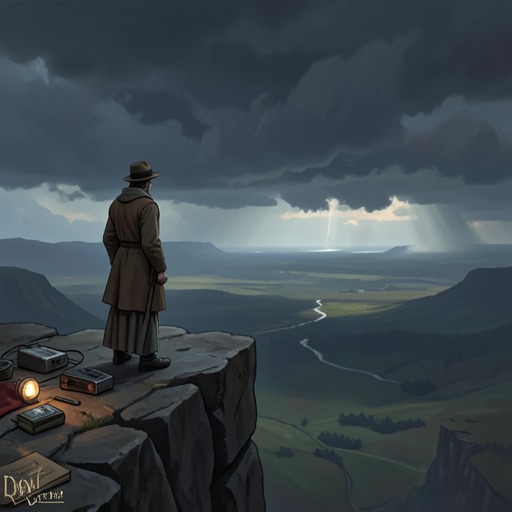
The crisis follows the raft’s violent passage through the underground flood. When Henry examines the cargo after the catastrophe, he discovers that most of it has disappeared. The loss is not limited to food: among the nautical and scientific instruments, only the chronometer and compass remain. Ladders and ropes have been reduced to a small piece attached to the broken mast, and the picks, crowbar, and hammer are gone. These missing tools matter alongside the shortage of provisions, since the party has lost much of its means of measuring, climbing, and working its way through the underground landscape.
Henry searches the raft’s joints and corners, hoping that supplies have merely shifted out of sight. His search finds only a little dry meat and some soaked, partly moldy biscuits. The contrast is sharp: the expedition had once carried provisions and equipment packed in separate groups for a planned journey, but after the wreck its apparent reserve has contracted to scraps. The storm has therefore made starvation part of a wider emergency, not an isolated hardship; even a larger supply would not by itself answer the danger of the torrent carrying the raft onward.
The Travelers Confront Hunger
Professor Hardwigg initially proposes that the party should eat to regain strength for whatever follows. Henry, who has delayed telling him the full extent of the loss, must then disclose that the single piece of dried meat in his hand is all that remains for the three travelers. The report stuns the Professor. For an hour, neither man speaks, and the last morsel remains untouched: Henry and his companions are hungry, but no one takes the food while the others go without.
That hesitation gives the shortage a social dimension. The remnant is not simply an individual meal to be seized; it is the last visible remainder of the expedition’s preparations, and dividing it means accepting how little those preparations can now provide. Henry’s retrospective judgment is correspondingly severe: he thinks the journey should never have begun, despite Professor Hardwigg’s enthusiasm and the parchment that set them on the route. Under starvation, the earlier decision to venture underground is re-examined from the standpoint of its consequences.
Hunger and the Prospect of Survival
Henry describes prolonged hunger as a condition that unsettles thought, explaining that the brain, deprived of food, fills with fantastic notions. His understanding is no longer theoretical: the ordeal makes him recognize what hunger means through immediate experience. At the same time, the party faces danger beyond deprivation. Their survival depends not only on how long the food can be made to last, but on whether they can escape the underground torrent and its other hazards.
Professor Hardwigg counters despair by insisting that there remains a chance of safety and that the travelers must prepare for whatever happens. His reasoning does not remove their predicament; it converts uncertainty into a reason to preserve their strength. He urges them to eat, and Henry finally shows him the remaining food. The practical counsel and the near-empty stores stand side by side: continued action requires nourishment, yet nourishment is almost exhausted.
Rationing the Remains
The surviving provisions are ultimately divided into three equal parts. Professor Hardwigg takes some of the meat and the biscuit crusts that escaped the wreck, making a portion for each traveler. Each has one pound of food to last for the time remaining underground. The division creates an explicit ration, but no assurance that it will be enough; the food’s duration is left dependent on the uncertain course of the expedition.
Starvation thus exposes the gap between the expedition’s scientific and practical ambitions. Instruments once promised observation, and ropes and tools promised movement through the subterranean world; after the wreck, the few survivors among those objects cannot meet the most basic need. The final ration is both a concrete measure of their dwindling resources and a decision to continue facing the danger with what remains.